

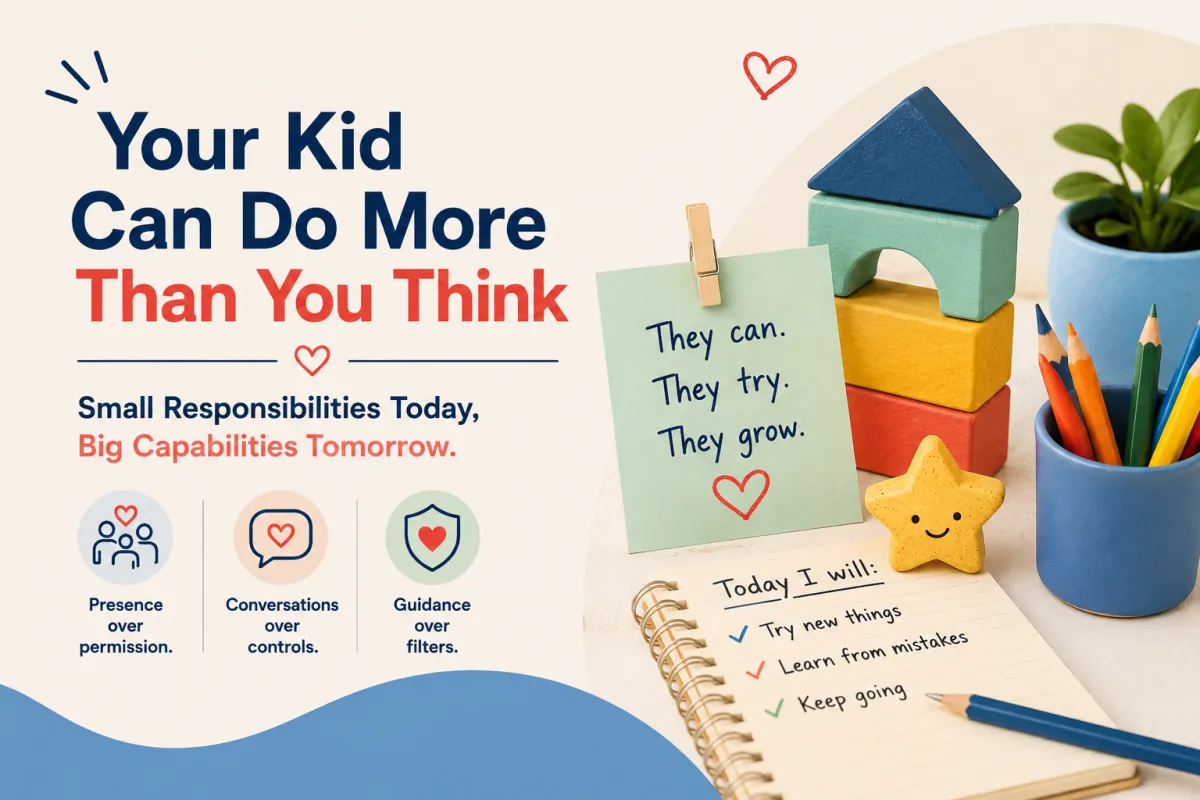
Your Kid Can Do More Than You Think
Your Kid Can Do More Than You Think
Quick quiz.
Who in your house can operate a smartphone, negotiate for a later bedtime like a seasoned attorney, and somehow locate the one snack you thought you successfully hid?
Right.
That kid.
So why can’t that same child make a sandwich?
Sometimes the answer is simple.
Because we keep making it for them.
Parents do this for good reasons. We can do it faster. We can do it better. We don’t want the mess. We don’t want them to struggle. And sometimes it is simply easier to say, “Here, let me do it.”
But something gets lost when we do too much for our children.
They lose the chance to discover what they can do for themselves.
Capability Needs Practice
Give a seven-year-old a real job.
Crack the eggs. Fold the towels. Push the grocery cart. Order their own meal. Help make dinner.
Then watch what happens.
Will there be eggshell in the bowl?
Probably.
Will the towels look like they lost a wrestling match?
Quite possibly.
That’s okay.
The imperfect result isn’t getting in the way of the lesson. It is part of the lesson.
A child tries.
Something doesn’t work.
They adjust.
They try again.
Eventually, something that once required Mom or Dad becomes something they can handle themselves.
That is how capability grows.
Don’t Prepare the Road for the Child
There is a natural temptation to make childhood easier.
But our job isn’t to remove every bump in the road.
It is to prepare our children to handle the bumps.
That means giving them responsibilities before they are completely ready. Letting them struggle with things they can safely struggle with. Allowing consequences to teach lessons that lectures rarely can.
And gradually handing over more ownership as they become capable of carrying it.
Because every skill a child truly owns is one less thing they will have to learn when the stakes are much higher.
It is better to learn how to manage $20 before managing a paycheck.
Better to forget the laundry than forget the electric bill.
Better to make a terrible sandwich at twelve than discover at eighteen that someone else has always handled ordinary life.
Small responsibilities today prepare children for bigger responsibilities tomorrow.
The Parent Still Leads
Stepping back doesn’t mean stepping away.
Parents still teach.
Parents still set boundaries.
Parents still decide what responsibility a child is ready to carry.
But good leadership changes as children grow.
At first, it may look like:
Watch me.
Then:
Let’s do it together.
Then:
You do it. I’ll help if you need me.
And eventually:
You’ve got this.
That progression matters.
Because the goal isn’t a perfectly folded towel, a spotless kitchen, or even a well-made sandwich.
The goal is the child who looks at something unfamiliar and thinks:
This Week’s Challenge
Catch yourself just before doing something your child could reasonably try.
Stop.
Hand it over.
Let them do it a little badly.
Don’t redo it simply because you could do it better.
Let them experience the satisfaction of owning the job from beginning to end.
One imperfect job they actually own is worth more than a perfect job they only watched you do.
Don’t measure the mess. Measure the capability being built.


