

A Program of Futures Fulfilled
THE READINESS CYCLE
See Today. Think About Tomorrow
Growing up happens right in front of us.
A chore gets done—or doesn't. A disagreement happens. A mistake is made. A responsibility is forgotten. A good decision catches us by surprise.
It's easy to see each one for what it is in the moment.
ReadiKids asks parents to see something more.
What is my child learning from this?
What are they practicing?
What are they ready to take on next?
Who are they becoming?
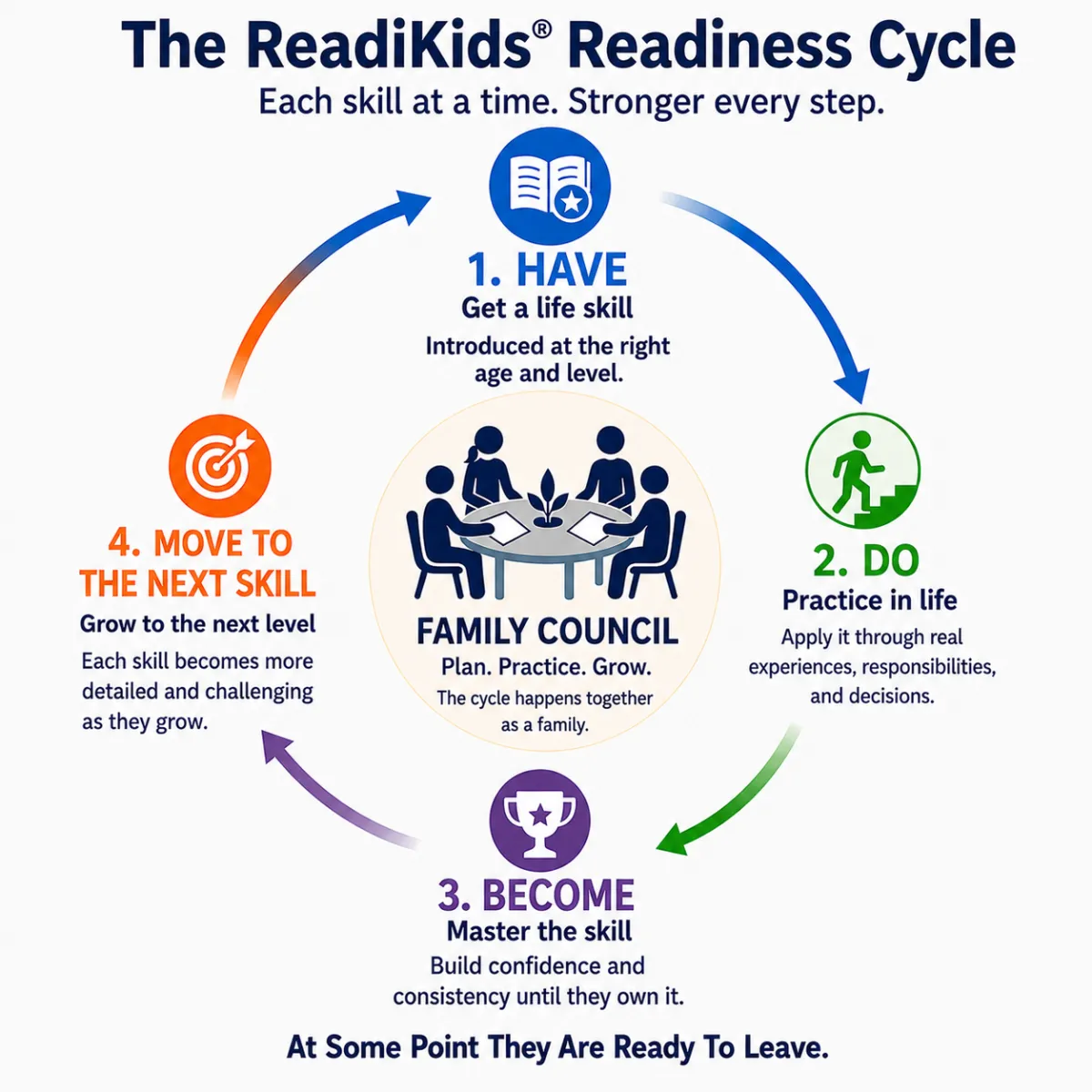
That is the thinking behind the ReadiKids Cycle.
HAVE. DO. BECOME.
HAVE — What should they be acquiring and carrying with them at this stage of life?
DO — Where can they practice it, use it, struggle with it, and learn to own it?
BECOME — How is it becoming part of who they are?
Then you look again.
Because your ten-year-old won't need the same things at fifteen. And your fifteen-year-old shouldn't need the same things at twenty.
The child keeps growing. The parent keeps noticing. The cycle keeps repeating.
ReadiKids Readiness Cycle gives parents a way to look beyond today's behavior and see the capable, confident, increasingly independent person developing underneath it.
The First Step
HAVE: What to Give Them Along the Way
Children don’t know what they will need at 10, 15, or 20. They don’t know which skills they are missing or which ones will matter when life asks more of them.
That is where parents come in.
We have the benefit of having lived ahead of them. We know that someday they will need to handle disappointment, manage money, speak up for themselves, keep a commitment, solve a problem, help someone else, make a difficult decision, and get back up when things don’t go their way.
Our job is to help put those things in place before they need them.
That is what the Readiness Pack is for. It gives parents a stage-by-stage picture of what their child can be learning and carrying with them across the Four Building Blocks: Practical Readiness, Mental & Emotional Readiness, Social & Civic Readiness, and Virtue & Character Readiness.
It helps answer a very practical parenting question: What should we be helping our child learn now?
Not everything at once. Not according to some rigid checklist. Just the skills, habits, attitudes, and qualities that make sense for this child, at this age, at this point in life.
Because without the HAVE, there is nothing meaningful to practice. The Readiness Pack gives parents direction. The Family Council gives the family a place to practice. And everyday life provides countless opportunities to make it real.
The Readiness Pack is never finished. It grows as the child grows — one skill, one responsibility, one experience at a time.
Parents decide what goes into the pack. ReadiKids helps them know what matters, when it matters, and how to begin.
The Three Stages
Little Explorer — Ages 0–10
Simple responsibilities that build foundational habits
Pathfinder — Ages 10–15
Real responsibility, real decisions, real consequences
Trailblazer — Ages 15–20
Full ownership in preparation for launch
The Second Step
DO: Where Readiness Comes to Life
Knowing how to do something and being able to do it when it matters are two different things.
A child can be told how to manage money, handle disappointment, keep a commitment, or solve a problem. But those lessons become part of them when they have the chance to try them, practice them, make mistakes, and try again.
And life gives them plenty of chances.
Meals. Money. School. Friends. Chores. Disappointments. First jobs. Mistakes. Conflicts. Decisions. Ordinary family life is full of moments when what is going into their Readiness Pack gets put to use.
A responsibility becomes a chance to learn ownership. A disagreement becomes a chance to practice respect. A mistake becomes a chance to make things right. A difficult moment becomes a chance to discover, I can handle this.
That is where capability grows.
The Family Council gives all of that practice a rhythm. It is a short, regular time when your family comes back together—to celebrate what went well, acknowledge growth, work through real problems, and decide who will take responsibility for what comes next.
The Four Anchors
Every Family Council follows the same four anchors: Celebrate what went well. Acknowledge someone who deserves recognition. Solve one real problem together. Act — assign clear ownership for the week ahead.
The Family Council isn't where every lesson happens. Life is the classroom. The Council is where the family notices what is taking hold, talks about what isn't, and decides what deserves a little more attention.
Over time, something begins to change.
The child who needed reminding starts remembering. The child who needed help with every problem begins solving some on their own. Responsibility feels less like something you give them and more like something they carry.
That's the DO.
Not just knowing. Doing. Practicing. Growing more capable through the ordinary experiences of life.
The Third Step
BECOME: Who They Are Becoming
At first, you do a lot for them.
You remind them. You show them. You make the decision. You step in when something goes wrong. You give them another chance when they don't get it right.
Then, little by little, something begins to change.
The child who needed reminding starts remembering. The child who needed help solving every problem begins working through some of them alone. The child who spent every dollar starts thinking about saving. The child who blamed someone else begins saying, “That was my responsibility.”
These may seem like small moments. But they are signs of something much bigger.
Your child is beginning to own their life.
The skills, habits, attitudes, and values carried in their Readiness Pack are becoming more than things they have learned. Through practice and experience, they begin to shape how your child thinks, responds, decides, and acts.
Responsibility becomes I can be counted on.
Resilience becomes I can get through this.
Judgment becomes I can think this through.
Character becomes I know what I stand for.
And it doesn't happen all at once.
It happens across years of growing up—in kitchens and carpools, at school and work, through friendships and disappointments, successes and mistakes. Sometimes the progress is easy to see. Sometimes it isn't. Sometimes they take two steps forward and one step back.
That is growing up.
You may be seeing BECOME when...
Reminding begins to become remembering.
Being assigned responsibility begins to become taking responsibility.
Asking “What should I do?” sometimes becomes “Here’s what I think I should do.”
Recovering with your help begins to become recovering on their own.
Following family values begins to become choosing those values for themselves.
Needing your direction begins to become seeking your perspective.
Readiness doesn't arrive on a birthday.
You see it emerging in moments like these.
The goal isn't to decide who your child will become. That belongs to them. Each child is a capable adult in training — someone who arrives at 18 not hoping they're ready, but knowing they are
Your role is to see them differently and help prepare them for the life that will increasingly become their own—to give them opportunities to practice, room to make mistakes, responsibilities to carry, values to guide them, and the confidence that comes from discovering what they can do for themselves.
Over time, your role changes too. You do a little less directing and a little more watching. A little less reminding and a little more trusting.
Until, at some point, they are ready.
The parent leads the preparation. The child increasingly owns the life.
The CYCLE
The Loop Runs.
The Skills Compound.
The Child Grows.
Each time the cycle repeats, something shifts.
The skill practiced last week feels a little more natural this week.
The responsibility owned last month takes less prompting this month.
The conversation that once felt awkward becomes one they eventually start themselves.
Most of the time, the change is almost too small to notice.
But small changes accumulate. Practice becomes more familiar. Responsibility becomes more natural. Lessons become habits. And habits begin showing up in how your child handles life.
Then one day, you notice something.
They handled the problem without coming to you. They kept the commitment without being reminded. They made a good decision when you weren't there to make it for them. They showed a little more judgment, resilience, responsibility, or character than they did before.
That's the cycle at work.
Not dramatic transformation. Not a promise that everything goes according to plan. Just something far more believable: small opportunities, repeated over time, giving your child the chance to grow increasingly capable of managing their own life.
That's why ReadiKids gives families a framework rather than leaving readiness to chance.
HAVE gives parents direction.
DO gives children practice.
BECOME is what begins to emerge.
Then the cycle continues.
Four Building Blocks
Define what life readiness is.
Readiness Packs
Define when and how it develops — by age and stage.
LIFE IS THE CLASSROOM
Everyday life is your greatest classroom to teach kids.
Family Council
Where it is practiced — every week, inside your home.
Start with the Family Council
The free entry point to the system. Learn the Four Anchors and download the Family Council Parent Guide.
How 30 minutes a week can change a family
Quick Links
© 2025 Futures Fulfilled. ReadiKids® is a registered trademark. All rights reserved.


