
A Program of Futures Fulfilled
A Program of Futures Fulfilled
LIFE READINESS
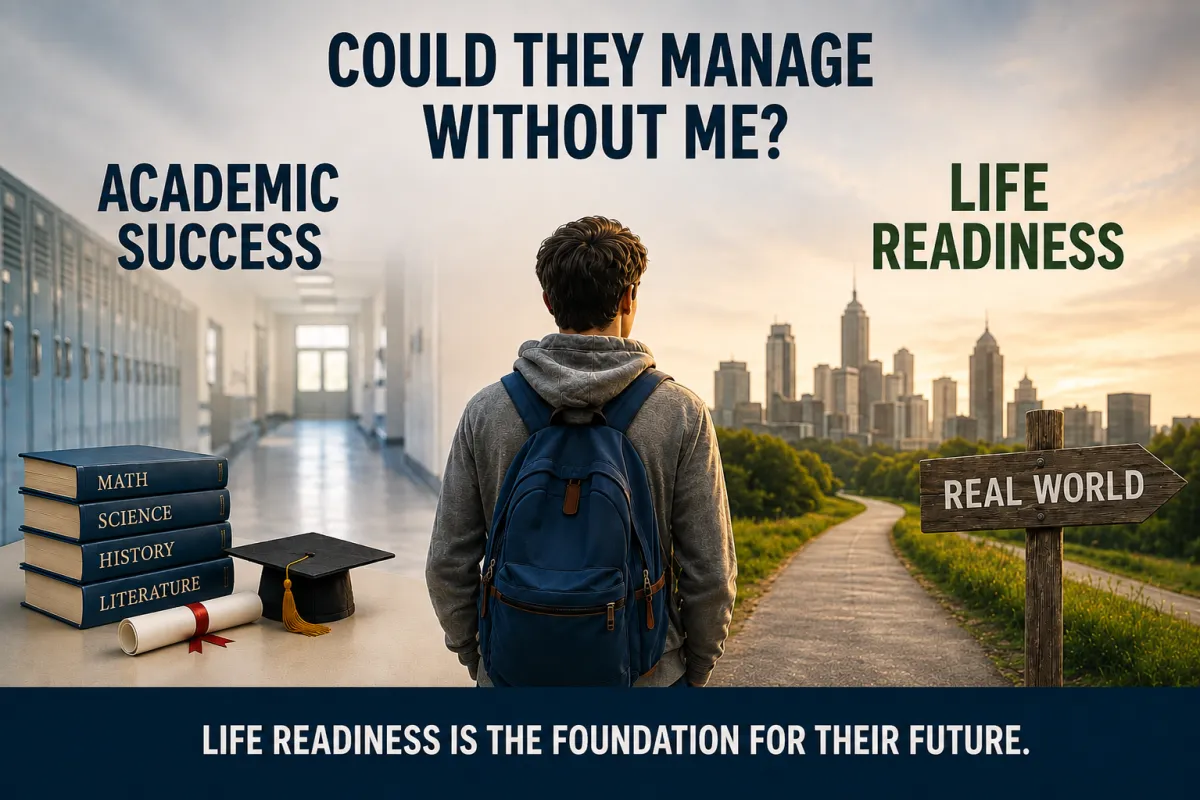
Could they manage without me?
Not manage in a crisis. Not manage with daily calls home for guidance. Manage — genuinely, independently — in the world that will be there when you are not.
That question is the one most parents are quietly carrying. It doesn’t show up on a report card. It doesn’t come up at a parent-teacher conference. But it surfaces — usually at an unexpected moment — when a parent looks at their child and wonders whether what they’ve built at home is actually enough.
It has a name - Life Readiness. And it is solvable.
A New Category
Life Readiness Is Not the Same as Academic Success.
Academic success measures a child’s ability to learn, retain, and perform within an educational system. It matters. A strong education creates real advantage in life. We are not dismissing it.
Life readiness measures something different. It measures whether a child can effectively function in the actual world — outside a classroom, without a teacher, without a grade, without a parent stepping in to smooth the path.
When the structure falls away, what is left? What life skills does that child carry into adulthood?
A student can graduate with honors and still not know how to open a bank account, have a difficult conversation, handle rejection without unraveling, or make a decision when no one is evaluating the outcome. This is not theoretical. It is what employers report every hiring cycle. It is what parents sense. It is what the data confirms.
“Schools teach academics. Families teach life readiness.”
Schools are institutions built to deliver academic outcomes at scale — and do that job with varying degrees of effectiveness. They are no longer effective in preparing a young person for life. Life readiness is a different job — one that has always fallen to the family, and that the family is uniquely equipped to deliver.
Definition
Life readiness is a child’s preparation across four Building Blocks — Practical Readiness, Mental and Emotional Readiness, Social and Civic Readiness, and Virtue and Character Readiness — that together determine their ability to function independently as an adult. A life-ready young person can manage money, navigate difficulty, communicate well, and guide themselves with integrity when no one is watching.
Academic Success Measures
Life Readiness Measures
Knowledge of subjects
Ability to apply knowledge in real, unscripted situations
Performance within structured systems
Capability when the structure is removed
Following instructions well
Making sound decisions independently
Meeting external standards
Meeting internal standards — integrity, virtue, character
Graduating from institutions
Launching into adult life with the capability to stay there
The Gap
The Missing Skills Behind the Diploma
The gap between what school builds and what adult life requires is not a theoretical problem. It shows up in specific, measurable ways — in the workforce, in apartments, in relationships, in the quiet of a difficult moment when no one is there to help.
Most parents already sense it. They see it in the morning routine that still requires prompting at fifteen. In the teenager who shuts down at the first sign of conflict. In the young adult who calls home not for connection, but for rescue.
These are not signs of a bad child or a failing family. They are symptoms of a preparation gap — one that is predictable, documented, and fixable.
Practical gaps — The Missing Skills Behind the Diploma
They don’t know how to manage money. Not in theory — in practice. Budgeting, saving, understanding debt, making trade-offs between what they want and what they can afford.
They can’t run a household. Cooking, cleaning, maintaining a living space, handling the logistics of daily life — these are not instinctive. They are learned through repetition, and repetition only happens if someone assigns the responsibility and holds the standard.
They haven’t developed real problem-solving. Many young adults have never had to figure something genuinely hard out for themselves — with real stakes and no safety net nearby.
They aren’t ready for work. Not for the technical skills — those can be trained. For the foundational ones: showing up consistently, following through without reminders, communicating professionally, navigating friction with a supervisor or colleague. Seventy-five percent of employers report that recent hires lack these basics.
Character and emotional gaps — the less visible ones:
The young adult who has never been allowed to fail has never discovered what they are made of. Resilience is not a personality trait. It is built through repeated exposure to difficulty, setback, and the experience of getting back up.
Integrity — doing the right thing when it costs something, when no one is watching, when the easier path is right there — is not taught in a classroom. It is modeled and expected over years inside a family.
These are not minor gaps. They are the gaps that determine the quality of a young person’s adult life.
The Readiness Challenge
The Data Confirms What Parents Already Sense.
This is not a character flaw.
Today's young adults are the product of a culture that removed the experiences that used to build life readiness — and replaced them with something that looks productive but doesn't build the same thing.
50%+
of 18–29-year-olds now live with a parent — the highest rate in modern American history
75%
of employers report recent graduates lack basic workplace communication and follow-through
$150B+
estimated annual cost to society from unprepared young adults
This problem has a history — and that history matters.
For most of American history, growing up included a proving ground. Teenagers worked real jobs with real stakes. They held genuine responsibility at home. Nobody called it life readiness. It just happened — because the structure of daily life required it.
Then that structure quietly disappeared.
Teen employment dropped from roughly 50% in 1979 to under 30% today. Academic pressure grew. Parents — reasonably, lovingly — began protecting their children from difficulty in ways that earlier generations simply couldn’t afford to. Each decision made sense at the time.
The problem is that the path itself was the training ground.
Before 1970, roughly 80% of young people were prepared for adult life. Today that number is approximately 50% — a 30-point drop in one generation, confirmed by Pew Research and employer surveys across industries.
This is not a parenting failure. It is a structural gap. The experiences that once built life readiness naturally have been removed from childhood — slowly, for understandable reasons, with the best of intentions.
The numbers are not shared to alarm you. They are shared because the gap between what parents sense and what the data confirms is smaller than most people realize. You are not imagining it.
The Family’s Role
This Has Always Been Yours to Build.
Schools are not preparing children for adult life. They can’t — not with the focus they now carry. They can produce a diploma. They do not produce a young person who can manage money, handle difficulty, work with others, and govern themselves when no one is watching.
Life readiness is a different mandate. It is built through lived experience, repeated expectation, and consistent relationship over time. It is built in the moment after failure, not the moment before the test. It is built in conversations in the car, expectations at the dinner table, and the disagreement that gets resolved instead of avoided. It is built in a home — specifically, in a home where a parent is leading with intention.
No curriculum can replicate this. No classroom can replace it. It has always been the family’s work, and the family is uniquely positioned to do it well.
Most parents already want exactly what life readiness describes. They want their child to be capable, resilient, financially grounded, and guided by real character. The desire is not the gap.
The gap is the system.
Good intentions without structure produce inconsistency. Life readiness is not built on good mornings. It is built through repetition, consistent expectation, and a structure that does not depend on anyone’s mood or available energy. Ray Kroc did not build McDonald’s on good food intentions. He built it on a system — a repeatable process that produced consistent results regardless of who was running it. A home that runs on a system produces different outcomes than a home that runs on hope.
This is not about being a perfect parent. It never has been. It is about being an intentional one.
The ReadiKids System
ReadiKids® is a parent-led readiness system designed to help families prepare children for adult life before they leave home. It organizes growing up around four essential building blocks and uses everyday family life as the classroom.
The Framework
Life Readiness Is Built Across Four Building Blocks.
Life readiness is not a single skill. It is the development of capability across four interconnected building blocks — each essential, each buildable, and each the family’s responsibility to cultivate. Think of these four as the walls of a house. Three strong walls and one weak one leaves the structure vulnerable. Life readiness requires all four.
Practical Readiness
Can my child function in daily life without me?
Managing money. Running a household. Navigating the systems of adult life. Showing up and following through at work.

Mental & Emotional Readiness
Can my child handle difficulty, stress, failure, and uncertainty?
Resilience is not a personality trait — it is a skill built through repeated exposure to hard things.
Social & Civic Readiness
Can my child work well with others?
Communication. Conflict navigation. Collaboration. The capacity to be a functioning member of a community — starting with the family.

Virtue & Character Readiness
Can my child guide themselves when no one is watching?
Integrity. Honesty. Accountability. Moral reasoning. The inner compass that makes every other capability trustworthy.
The Solution
The Readiness Gap Is Solvable. Here Is How Families Proceed.
The readiness crisis is not a mystery. It is the predictable result of identifiable forces. And its solution is equally predictable: restore what was removed. Responsibility. Rhythm. Contribution. The family’s original role as the primary developer of capable human beings.
Life readiness is not built in dramatic moments. It is built in the small, consistent practices of family life. A child who participates in a structured weekly family meeting for five years has practiced communication, problem-solving, accountability, and responsibility hundreds of times — in the safety of a family that loves them. That child does not arrive at adulthood hoping they are ready. They arrive knowing they are.
1
Give children real ownership over real things.
Start with something small. Something age-appropriate. Something with an actual consequence if it doesn’t get done. The transfer of genuine responsibility — incrementally, deliberately — is the mechanism through which readiness is built.
2
Create a weekly rhythm.
Capability is not built in breakthroughs. It is built in repetition. Twenty to thirty minutes a week, same day, same time — a structured moment where your family gathers, celebrates progress, solves a real problem, and assigns clear ownership.
3
Lead from inside the home.
No program, curriculum, or outside expert can do what a parent does. The ReadiKids® system is not a replacement for parental leadership — it is the tool that makes parental leadership consistent, structured, and sustainable. You are the captain. ReadiKids is the navigation system.
“The parent leads. ReadiKids equips. The child becomes.”
Quick Links
© 2025 Futures Fulfilled. ReadiKids® is a registered trademark. All rights reserved.


