
A Program of Futures Fulfilled

A Program of Futures Fulfilled
The Family Council
Less than 30 Minutes a week. A Lifetime of Readiness.
Most families run in reaction mode. Something breaks, emotions flare, the moment passes — and the same problem comes back next week. The Family Council changes that pattern permanently.
It is a short, repeatable, weekly family meeting — same day, same time, up to 30 minutes — that gives your family a structure for celebrating wins, solving problems before they compound, and transferring ownership of real responsibilities to your children. Parents lead. Children participate. And week by week, something shifts.
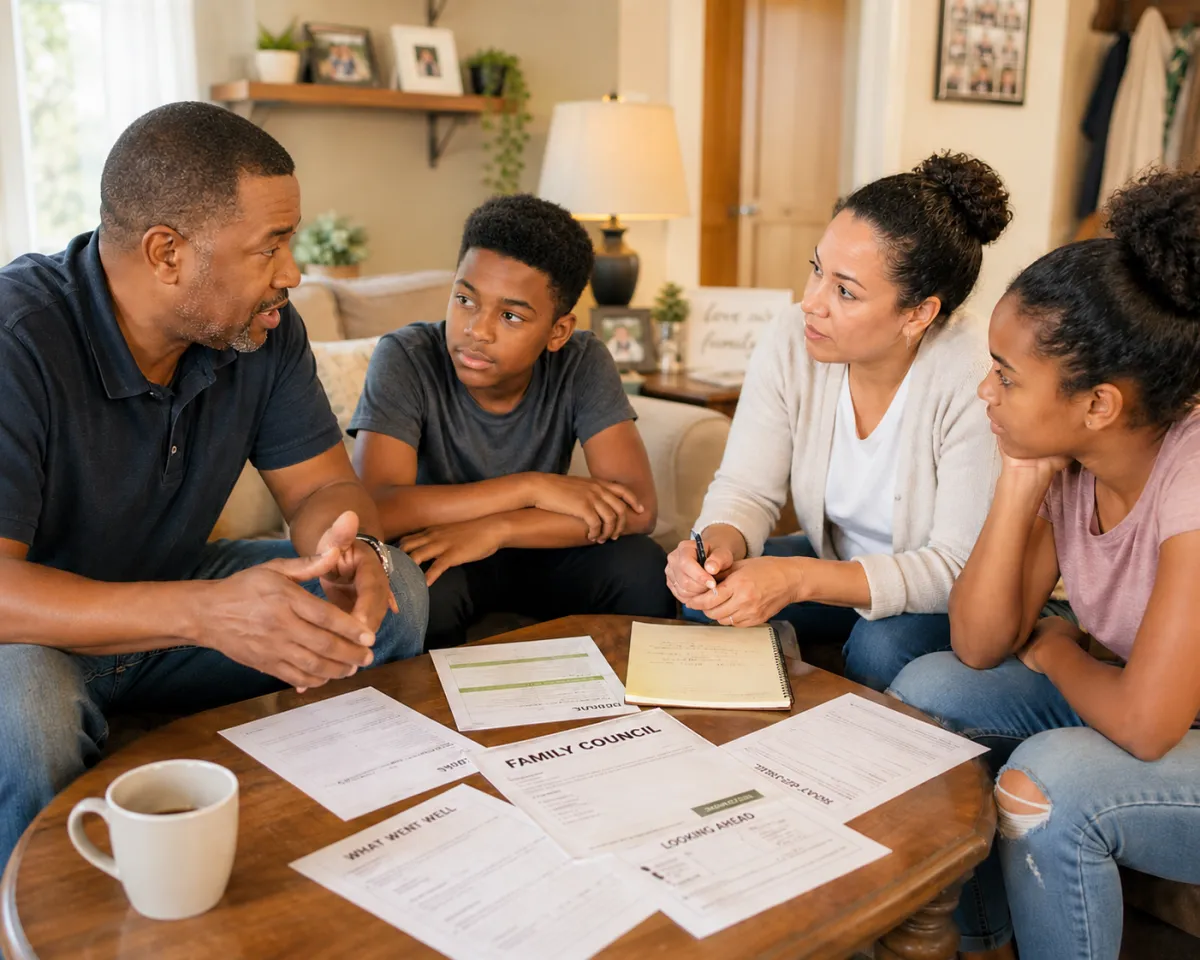
Finding time for a weekly Family Council may feel impossible — until you realize how much clarity, calm, and connection it creates. Once you see that, you make time.
The Practice
The Family Council is a short, structured weekly meeting where your family gathers — same day, same time, same place — to celebrate what went well, acknowledge what didn’t, solve one real problem together, and assign clear ownership for the week ahead.
That’s it. Four anchors, followed in order, completed in 20 to 30 minutes. No phones. No laptops. Parents lead, but children do not just listen — they speak, they think, they propose, they own.
Over time, the meeting becomes a rhythm. The rhythm becomes a habit. The habit becomes the way your family operates. And the child who practiced communicating, problem-solving, and owning responsibility inside that meeting eventually carries those capabilities out the door with them.
Families Who Run the Family Council Consistently Report:
Less conflict and fewer repeated arguments
More initiative from children without prompting
Clearer expectations that everyone understands
Better follow-through on responsibilities
A calmer, more intentional home
The Parent’s Role in the Room
You are the captain of the ship — the one who sets the course, calls the meeting, and ensures the voyage moves toward the destination. Calm, consistent, fair. You guide the process and make final decisions. When emotions run high — and they will — leadership in that moment teaches your child something more powerful than the meeting’s agenda: that problems can be handled without chaos.
Life becomes the classroom. Problems become lessons.
The meeting is where children practice being the adults they are becoming.
The Structure
Introducing:
The Four Family Council Anchors
The consistency is what makes it work. Families that vary the format lose the rhythm. Families that keep to the sequence find that even difficult meetings end productively — because the structure holds when emotions don’t. All four anchors should be addressed before the meeting ends.
1
Celebrate
“What went well this week?”
Why it matters: Confidence grows before competence. When children learn to notice progress — even imperfect progress — they begin to see themselves as capable. Starting here trains the whole family to look for what is working, not just what isn’t. Over time, this shift in attention is one of the most powerful changes the Family Council produces.
Practical tip: Every person shares at least one win — big or small. Parents share too. Modeling matters here.
2
Acknowledge
“Who deserves recognition this week?”
Why it matters: Celebration focuses on events. Acknowledgment focuses on people. Each family member names something they genuinely appreciate about another — a specific behavior, a kind word, an act of responsibility. You cannot solve problems well in a family where people don’t feel seen.
Practical tip: Specificity matters. “I noticed you helped your brother without being asked” is acknowledgment. “Good job” is not. Train children to be specific from the first meeting.
3
Solve
“What challenge shall we work on?”
Why it matters: Not every issue needs to be solved at once. Choose one real problem. Briefly brainstorm possible solutions. Parents make the final call. This anchor teaches children that problems can be handled thoughtfully rather than reacted to emotionally. Critical rule: let children suggest solutions first.
Practical tip: One problem per meeting. State it without blame — describe what happened, not who is at fault. Let the youngest speak first. Whatever the parent decides, the decision is final and explained.
4
Act
“Who owns what this week?”
Why it matters: Every meeting ends with clear ownership. Each family member leaves knowing exactly what they are responsible for before the next meeting. This is where the ownership habit is born — through the repeated experience of owning something and reporting back on it.
Practical tip: Each task needs one owner, one clear action, and one deadline. Write it down. At the next meeting, the first thing checked is: who did what they said they would do?
Handling Resistance
Expect Resistance.
That's Predictable.
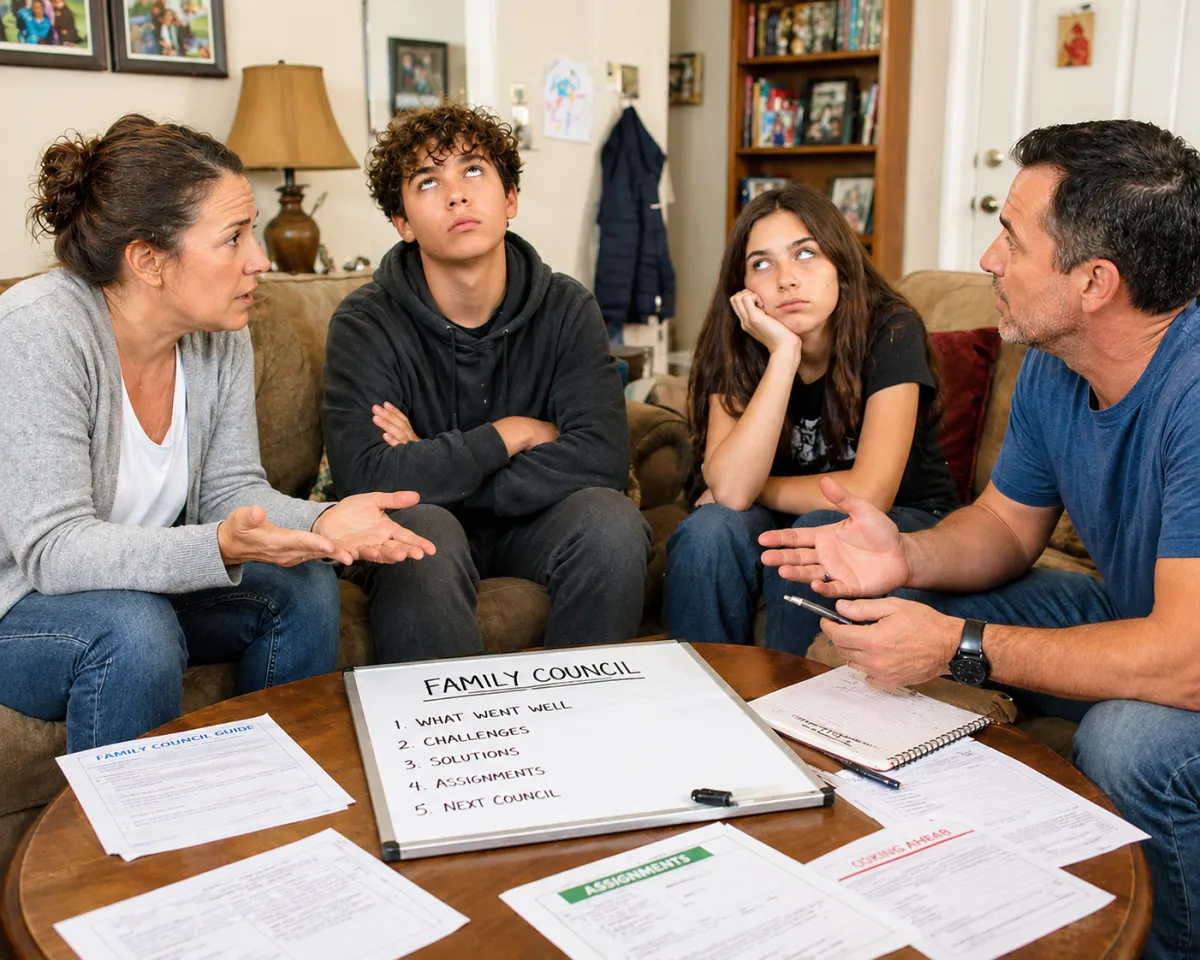
Especially teenagers. Eye rolls are to be expected. Monosyllabic answers. “Do we have to?” and “This is boring.” All of it is normal and none of it is a reason to stop.
The meeting’s existence should not be negotiated. The content, the tone, and the child’s level of participation — those can be shaped. But a parent who cancels the Family Council the first time a teenager complains has communicated something that will take months to undo: that this family’s commitments are conditional on how everyone feels that week.
Find something to laugh about.
A note on older teenagers:
A fifteen-year-old who resists the Family Council is not broken — they are developmentally on track. The resistance is healthy individuation. The opportunity is to hold the structure with calm confidence, no argument - just discussion. The teenager who rolls their eyes at fifteen is often the young adult who calls home at twenty-two to tell you it was the most useful thing you ever did for them.
What to Say When They Resist
What Children Say
What You Say Back
“Do we have to?”
“Yes. And I want to hear your ideas.”
“This is boring.”
“Tell me one thing that wasn’t boring this week.”
“Can we skip it this week?”
“This is one thing we don’t skip.”
“I don’t have anything to say.”
“You always have something. I’ll wait.”
“Nobody else’s family does this.”
“We’re building something most families don’t have.”
“Why do you get to make all the decisions?”
“Because I’m the parent. And I want your input first.”
Getting Started
Start This Week.
The First Meeting Won't Be Perfect.
The biggest barrier to starting the Family Council is the belief that you need to have it figured out first. You don’t. The Starter Kit gives you everything you need to run your first meeting — an agenda, a first-meeting script, discussion prompts, and the Four-Anchor framework — in one free download.
Pick a day. Pick a time. Tell your family it’s happening. Then run the meeting. It will be awkward the first time. That is expected and normal. Structures feel forced before they feel natural. The only way through it is to keep going.
What the Free Starter Kit Includes:
Four-Anchor meeting agenda — print and use at the table
First-meeting script — exactly what to say to open, run, and close the first council
Discussion prompts by anchor — starter questions for each section
Responsibility Week challenge — a 7-day assignment to establish ownership before the first meeting
Free. No account required.
Now that you have the meeting, here's what to build inside it.
Ready to Run Your First Council?
Free. No account required.
Everything you need to start this week.

Families are the foundation of a kid’s life. Creating a solid family founded on virtue, resilience, independence, problem-solving, and communication causes a child to be a contributing member of society. Start a Family Council.
Get the Starter Kit
Every parent wants their child to thrive—not just in school, but in life. ReadiKids® makes that possible.
We provide fun, practical tools that help kids build essential life skills while strengthening the family along the way.
From morning routines to managing big emotions, our storybooks, games, workshops, and daily missions empower children ages 4–17 to grow into confident, capable young adults.
This isn’t about perfect parenting. It’s about real families building strong foundations, one day at a time. ReadiKids® is your partner in raising kids who are ready to take on the world.
Because when kids are ready, families thrive.
Be a leader in your child’s life.
Explore the ReadiKids System

GET STARTED
They Are My Kids
Parent support network
Futures Fulfilled
Book Site
Newsletter
Quick Links
© 2025 Futures Fulfilled. ReadiKids® is a registered trademark. All rights reserved.


