
A Program of Futures Fulfilled

A Program of Futures Fulfilled
The Four Building Blocks
Their Foundation Is Built at Home
Life readiness is not a single skill. It is the development of capability across four interconnected building blocks — each essential, each buildable, and each the family’s responsibility to cultivate.
Think of these four as the walls of a house. Three strong walls and one weak one leaves the structure vulnerable. A child who is practically capable but emotionally fragile will crumble under real pressure. Life readiness requires all four — developed deliberately, across the years of growing up, inside the family that loves them most.
Start with a solid foundation and build with a purpose.
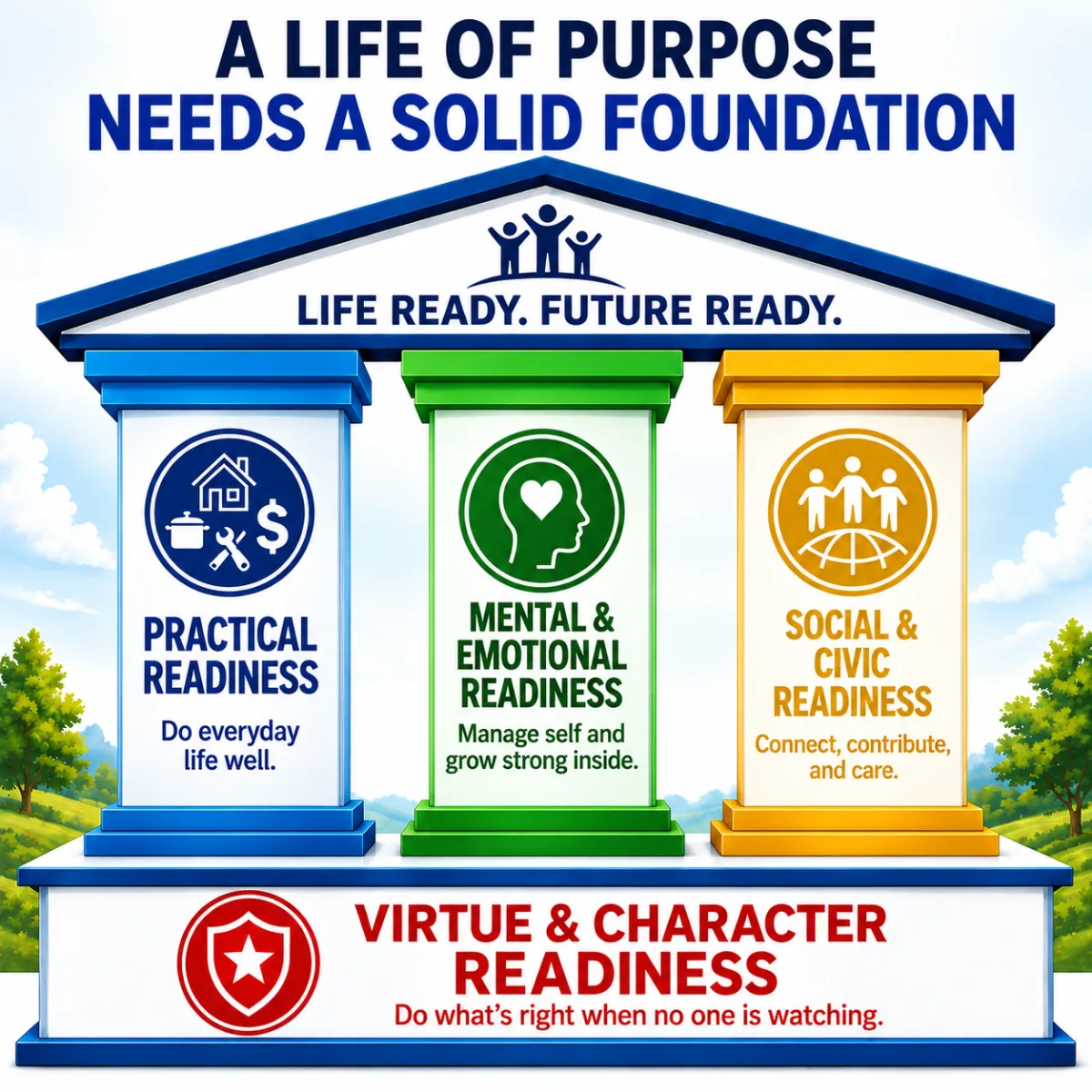
“The Family Council is the gym where all four building blocks get built — one week at a time.”
Building Block 1
Practical Readiness
Can my child function in daily life without me?
Practical readiness is the foundation. Before a young person can manage their emotional world, they need to be able to manage their physical one. Cooking a meal. Handling a household emergency. Managing a budget. Filing taxes. Scheduling a doctor’s appointment. These are not adult mysteries to be revealed at eighteen — they are capabilities that must be built, skill by skill, across the years of growing up.
The family is the perfect training ground for practical skills because the stakes are real but the consequences are manageable. A ten-year-old who cooks dinner once a week has more than 500 meals of practice before they leave home. That child does not arrive at the apartment wondering how to feed themselves.
Little Explorer (0–10)
Set the dinner table, pack backpack independently, sort and put away laundry
Pathfinder (10–15)
Plan and cook one family dinner per week, manage a personal budget, do own laundry
Trailblazer (15–20)
Manage household budget for a family activity, schedule own appointments, lead a family meal plan for a week
Practical readiness is not chores. It is the transfer of actual household competence — one responsibility at a time — until the child can run a household without you.
Financial Management
Budgeting, saving, avoiding debt, understanding how money actually works
Household Management
Cooking, cleaning, laundry, basic maintenance and repairs
Self-Sufficiency
Making appointments, navigating healthcare, managing time
Real-World Problem-Solving
Knowing what to do when something goes wrong and no one is there to fix it
Work Ethic
Showing up, completing what is started, handling setbacks without quitting

Building Block 2
Mental & Emotional Readiness
Can my child handle difficulty, stress, failure, and uncertainty?
Of all four building blocks, mental and emotional readiness is the one most families feel — but least intentionally build. Parents see it when their teenager shuts down at the first sign of difficulty, when a child cannot tolerate frustration, when a setback becomes a crisis rather than a lesson. This is not a generation that lacks intelligence or ambition. It is a generation that has been protected from the very experiences that build grit.
Resilience is not a personality trait. It is a skill — formed through repeated exposure to difficulty, supported by a family that knows how to guide the process without eliminating the struggle. The Family Council’s Acknowledge and Solve anchors are among the most powerful tools available for building this capacity.
Little Explorer (0–10)
Try something hard before asking for help, name how they feel at Family Council, finish something frustrating
Pathfinder (10–15)
Present a problem at Family Council and propose a solution, manage disappointment without parent intervention
Trailblazer (15–20)
Navigate a workplace conflict, take on a challenge with real failure risk, report what was learned from a setback
Children do not become resilient by being told to be strong. They become resilient by being allowed to struggle — and supported through what they discover on the other side of it.
Special Focus: Resilience
Resilience is simultaneously the most cited gap in employer surveys and the least deliberately built at home. The shift that matters most is moving the conversation from mental illness to mental resilience — one frames children as patients in need of treatment, the other frames them as developing adults in need of preparation. Equip children before the pressure arrives, and the pressure will not define them.
Resilience is built through three things the family uniquely controls: allowing children to experience difficulty without rescue, modeling how to handle setbacks without collapse, and using structured family time (the Family Council’s Solve anchor) to practice problem-solving in a safe environment.
Resilience & Grit
Getting back up, persisting through difficulty, learning from failure
Emotional Regulation
Identifying and managing emotions, staying functional under pressure
Critical Thinking
Evaluating information, distinguishing feeling from fact
Earned Confidence
Self-belief built through actual effort and capability, not external praise
Adaptability
Handling change, uncertainty, and situations with no obvious right answer

Building Block 3
Social & Civic Readiness
Can my child work well with others and contribute to something larger than themselves?
No one succeeds alone. The young adult who cannot communicate clearly, navigate conflict without drama, or contribute to a team is limited regardless of their technical skills or academic achievement. Relational capability is the hidden variable in almost every outcome that matters — in the workplace, in marriage, in friendship, in community.
The family is the first and most powerful classroom for every relational skill. It is where children first learn to negotiate, to listen, to disagree without contempt, to repair a relationship after rupture, and to understand that they are part of something larger than themselves. The Family Council teaches relational skills by practice, week after week, in the safest environment a child will ever know.
Little Explorer (0–10)
Share at Family Council in a full sentence, acknowledge a sibling for something specific, resolve a small conflict
Pathfinder (10–15)
Lead a section of the Family Council, volunteer in a community setting, navigate a friendship difficulty
Trailblazer (15–20)
Lead a full Family Council meeting, manage a team project, represent the family in a civic commitment
Communication is not a personality trait. It is a learnable skill. The Family Council teaches it by practice, week after week, in the safest environment a child will ever know.
Clear Communication
Expressing thoughts, asking for what you need, listening with genuine attention
Conflict Navigation
Disagreeing without contempt, seeking resolution, repairing relationships after rupture
Collaboration
Working toward shared goals, contributing to a team, supporting others’ success
Civic Responsibility
Understanding their role in a community, contributing beyond their own household
Respect & Empathy
Recognizing others’ perspectives, responding with dignity even in disagreement

Building Block 4 — Most Important
Character & Virtue
Can my child guide themselves when no one is watching?
⚠Virtue - The Most Important Building Block
Virtue is the most important building block — and the most quietly built. It does not appear in a lesson, a workshop, or a motivational speech. It forms slowly, over years, through the accumulation of small decisions, consistent expectations, and the modeling of the parents who lead the family.
Virtue is not about being perfect. It is about having a reliable internal compass — integrity that holds when it’s inconvenient, courage that shows up when it’s uncomfortable, honesty that persists when no one would notice the shortcut. The Family Council creates a weekly structure where character is noticed, named, and practiced. What gets noticed gets repeated. It is upon virtue that character stands.
“Virtue is the foundation that makes everything else work. Practical skills without integrity produce someone who cuts corners. Resilience without accountability produces someone who never owns their failures. Virtue is not a supplement to the other three building blocks — it is the ground they all stand on.”
Little Explorer (0–10)
Tell the truth when uncomfortable and see it acknowledged, complete responsibility even when they don’t feel like it
Pathfinder (10–15)
Acknowledge a moral mistake at Family Council without deflecting, choose the harder right path in a peer situation
Trailblazer (15–20)
Operate with integrity at work when no one would notice a shortcut, mentor a younger sibling in a virtue they’ve developed
The Three Questions
Ethics asks: Should I do this?
Morals ask: What kind of person am I?
Integrity answers: Do my actions match my words?
The Three Components of Virtue
Virtue is built on three interconnected components. Understanding how they differ is what makes them teachable. Parents who can name the difference can teach the difference.
⚖️
Ethics
The inner voice that asks “What is the right thing here?” — even when no one is watching and the easy path is right in front of you. Ethics in action are contagious: your children learn by watching what you do when you admit a mistake or tell the truth.
Ethics asks: Should I do this?
🧭
Morals
The deep-down beliefs about right and wrong passed down through family, tradition, and faith. If ethics are the compass, morals are the North Star — steady even when everything else shifts. Children need a foundation that doesn’t wobble every time a new trend rolls through.
Morals ask: What kind of person am I?
🔗
Integrity
Integrity is what holds the other two together. It means what you say matches what you do — consistently, over time, even when it costs you something. People can count on you. You own your choices. You fix what you break. That’s the kind of strength worth passing on.
Integrity: Your actions match your words.
Why Virtue Matters More Than Parents Realize
Research documents that adolescents with strong virtue-oriented lifestyles experience 20 to 30 percent lower stress levels — a reduction comparable to what is seen in cognitive-behavioral therapy. Building character is also building mental health. The two are not separate tracks.
Virtue grows from everyday stuff: how you talk about truth at the dinner table, how you own up to a mistake in front of your children, how you treat others when no one who matters is watching. It is caught more than taught — which is exactly why it belongs to the family, and to no one else.
Integrity
Doing what is right when it costs something, when no one would know the difference
Honesty
A default toward truth even when falsehood would be easier
Accountability
Owning outcomes, including failures, without excuse or deflection
Add Subtext text. Click "Edit Text" to update the font, size and more.
To change and reuse text themes, go to Site Styles.
Courage
Speaking up, taking on hard things, moving forward in the presence of fear
Moral Reasoning
Thinking through ethical decisions and choosing rightly even at a cost
Self-Direction
Knowing what one values and allowing that to guide behavior without external pressure
Practice All Four Every Week
The Family Council is how all four building blocks get built — one week at a time.
Quick Links
© 2025 Futures Fulfilled. ReadiKids® is a registered trademark. All rights reserved.


